A Day in the Life of a Civil Engineer – Day 6

Day 6

Staff Development Meeting

This morning we had our staff development meeting where all representatives of all departments meet to discuss active developments in our city. Today we talked about several proposed and on-going prospects along with some discussion of proposed changes to regulations. One of these issues related to the creation and management of historic districts will be further discussed tonight at the council meeting. For those who are interested, here is the link to our live meetings that begin at 7 pm CST: http://www.geneva.il.us/channel10.htm

Southeast Plan

Last year, the city applied for and secured a grant to study a large undeveloped area lying southeast of our city. This area currently lies outside of our corporate limits. But based on existing boundary agreements most of it will annex to our city should owners decide to pursue annexation at some point. We are about half-way through studying and preparing the plan. Today we met to further discuss access and transportation elements.

Permits and Bonds and Insurance Claims

I had several calls and emails today related to permits and bonds required for the work. One was the followup from last week. Another was a claim we received for alleged damage to a vehicle on one of our road projects which I passed along to our contractor. I also prepared a review letter with comments for a development asking to install an improvement along their parking lot.

Other Miscellaneous Tasks

The other part of my day was spent preparing the property owner information for the block where we plan to construct a new parking lot. Our interns had done most of the research work running down the current owners and copying the deeds. However, I needed to review them and put them on the map in the correct locations. Tomorrow I will finish this up so I can send it to the city attorney. He will then prepare the necessary documents for the areas where we need easements.

I also tried to get through more of my email but didn't make much of a dent. All together it sure seems like meetings and email take up a lot of everyone's day. The key is trying to find the time in between to get all the work done!


Share

U.S. Army Corps Revamps Permit Application Process

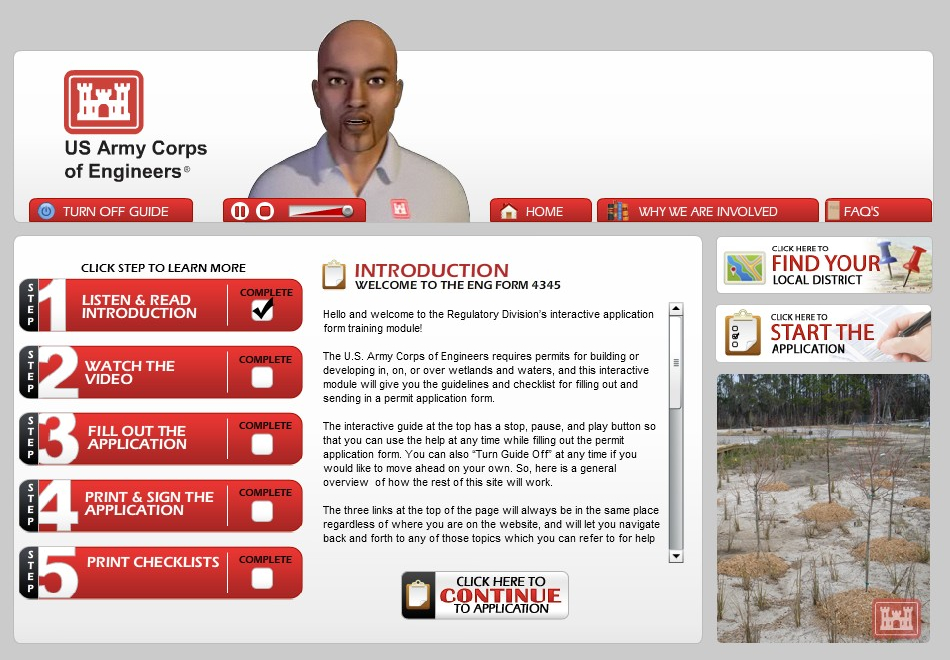
Those of you who navigate the U.S. Army Corp of Engineer's (USACE) permit application process might want to check out their new, online site designed to guide applicants through each step of filing a permit application. Visitors to the Website, located at http://www.usace.army.mil/CECW/Documents/avatar2/index.html, are greeted by an avatar who explains the site and offers advice for moving through each step. He encourages users to first watch a video that goes into more detail about how to apply for a permit using this interactive, online method.

USACE Permit Application SiteThe narrator in the video covers each section of the application and shows examples of how to fill out each piece of information. A transcript of the narrative can also be downloaded for further reference. After viewing the video, users can move on to filling out the permit application. A progress bar is provided to show how much is left to be done. The applicant can print out the application after all steps have been completed. 

Although I thought the new, online permit process was a great improvement, one other aspect of the site that impressed me were the sections titled "Why we are involved" and "FAQs." These sections give a  explanations of how the USACE is involved in this process, why the process exists, and other information an applicant is probably wondering about. I think this is very important because those of us who work for government sometimes get so used to all the rules and regulations that we end up taking this knowledge for granted. And then we forget that non-government employees are not going to just know the rules, the process, and the terms. So it is encouraging to see a government agency placing information on a site like this that explains why someone is going through the process.

Share

A GPS Twist on Overweight/Oversize Permits

Each city seems to have set up some form or policy for issuing overweight/oversize permits. But other than filling out the form and securing necessary certificates of insurance, what else should be done to perform a proper review? And how can GPS eventually help improve this process?

My thoughts on the overweight loads are that engineering can figure out the load on the pavement and the strength of the pavement. But for most urban streets, the base becomes the primary concern. And if the base is the controlling factor, the engineers performing the review have to rely on their knowledge and experience with their own street system.

But what happens if a certain delivery is necessary for a business, and the only way is along a road that can’t handle the weight. Can you or do you deny the permit? If you deny access, this can quickly move to a political situation. Because how can the city prevent a critical business in town from receiving equipment or product needed for an important expansion?

As for the oversize loads, the issue seems somewhat more straightforward. For this situation, the primary concern is the ability to navigate the width and height of the roadway. And if lines or signals have to be moved, the freight company takes that responsibility.

The other concern with these permits is how to verify that the load followed the route specified by the permit. Some cities require a police escort. However, many do not have the staff to provide this service. So I was wondering the other day if GPS could be used to improve the permitting process. Many trucks have GPS already installed. What if a city required all permitted loads to submit a route map to prove their vehicle took the correct streets? If the map did not match the permit, a fine could be issued. Would it also be possible to allow real time, online viewing of the truck driving once it got within a certain range of the city?

Do you have a specific review process for overweight/oversize loads or do you have any thoughts on the use of GPS to improve this process?

Share